IMPETUS | JAGATH WEERASINGHE

31 August - 30 September 2023
  • Impetus presents Jagath Weerasinghe’s spontaneous and sporadic response to the brutal violence and tumultuous social and political events in Sri Lanka between 1983 and 1989. It exhibits works from 1989 to the mid-90s, created in the years preceding his 1992 Anxiety (Kansawa) show. The exhibition aims to define the visual, intellectual and thematic precursors that defined Jagath Weerasinghe’s three-decade-long career.


    The images of decapitated heads, broken stupas and beastly human figures with contorted and elongated features become the visual devices that guide his intellectual inquiries. Weerasinghe’s oeuvre is a cathartic unfolding of an internal turmoil, characterised by a cognitive and emotional struggle to comprehend Sri Lanka’s post-independence landscape.
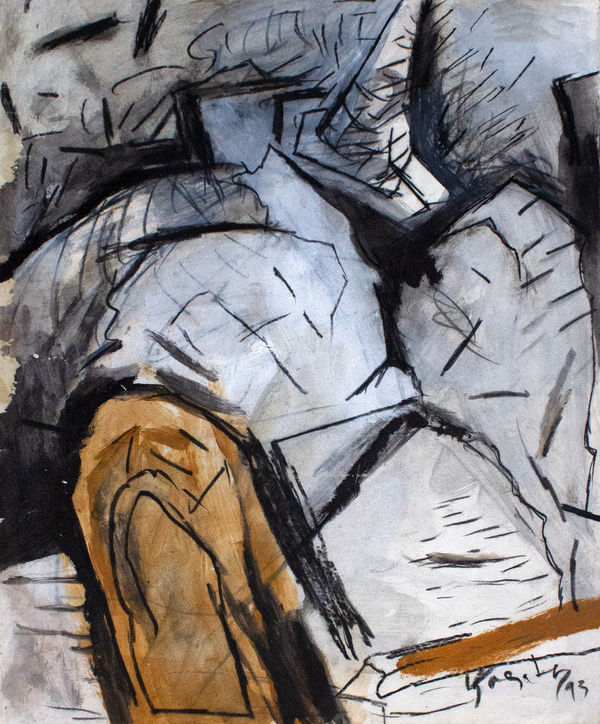
  • Jagath Weerasinghe, A Man, 1993

    Jagath Weerasinghe

    A Man, 1993

    My mind that raced across the Galle Road was gripped by an unknown fear... Hideous beastly figures emerged in the street in the distance. I saw them burning away at will, and sucking human flesh and blood. Those magnificent creative monuments of man's age-old annals broke into bits within my being.

    - Jagath Weerasinghe

     
    • Jagath Weerasinghe Self Portrait, 1989 Woodcut Print on Paper 30 x 28 cm 11 3/4 x 11 in Artist Proof
      Jagath Weerasinghe
      Self Portrait, 1989
      Woodcut Print on Paper
      30 x 28 cm
      11 3/4 x 11 in
      Artist Proof
    • Jagath Weerasinghe Self Portrait with Dambulla, 1989 Woodcut Print on Paper 35 x 33 cm 13 3/4 x 13 in Edition 6 of 10
      Jagath Weerasinghe
      Self Portrait with Dambulla, 1989
      Woodcut Print on Paper
      35 x 33 cm
      13 3/4 x 13 in
      Edition 6 of 10
    • Jagath Weerasinghe Bheeshanaya - Face, 1989 Woodcut Print on Paper 31 x 31 cm 12 1/4 x 12 1/4 in
      Jagath Weerasinghe
      Bheeshanaya - Face, 1989
      Woodcut Print on Paper
      31 x 31 cm
      12 1/4 x 12 1/4 in
    • Jagath Weerasinghe Faces, 1989 Woodcut Print on Paper 34 x 32 cm 13 3/8 x 12 5/8 in
      Jagath Weerasinghe
      Faces, 1989
      Woodcut Print on Paper
      34 x 32 cm
      13 3/8 x 12 5/8 in
  • Jagath Weerasinghe, The Face, 1994

    Jagath Weerasinghe

    The Face, 1994

    The erasure of familiar features from the human face has become a device in Weerasinghe’s work through which he delves into the human–inhuman dichotomy. Jagged lines that run along the entire length of the portraits in Faces (1989) are deliberate attempts to destroy traces of any identifying features. Inasmuch as it is a physical act of destroying any markers of identity, it also showed his cognitive inability to associate himself with the label of being a Sinhala Buddhist. It seeks to disengage and dissociate from a reality made unbearable by the manifestation of brutality housed within humankind. 


  • Jagath Weerasinghe, Stop Light, New York City, 1989

    Jagath Weerasinghe

    Stop Light, New York City, 1989
    Jagath Weerasinghe’s Long Necked Man exhibits a vulnerable acceptance that is overridden by a culturally-rooted fear of being perceived as weak, giving rise instead to the assertion of phallic dominance.
  • Jagath Weerasinghe, Long Necked Man, 1989

    Jagath Weerasinghe

    Long Necked Man, 1989
    Weerasinghe’s work criticises the justification of state-led violence, interlaced with religious extremism and nationalism, as a necessary tool for maintaining stability and peace within the country. It is a theme that echoes in his contorted Long-Necked Man - a figure that translates mental anguish into a more visible and physical form. It reflects on the intertwined relationship between vulnerability and masculinity, and its association with violence.
  • Jagath Weerasinghe, Dancing Shiva, 1995

    Jagath Weerasinghe

    Dancing Shiva, 1995

    Shiva is a compelling image of the activity, beautiful, elegant, and violent, which probes into the necessity of destruction to create an environment of peace and tranquillity.  Shiva Nataraja dancing on Apasmara Purusha, the personification of illusion and ignorance), is symbolic of the victory of good over evil, knowledge over ignorance. His recurrent engagement with the themes encapsulated in Shiva attempts to comprehend the cruelty that lurks within each human being - channelled as it is by an attachment to one’s personal beliefs and notions of culture. Through the repetition of the image, Weerasinghe inquiries into the manner in which the civil war in Sri Lanka was brought to an end & the necessity of violence to create an environment of peace. Is violence the only way to end evil?

  • Jagath Weerasinghe, The Rock, 1991

    Jagath Weerasinghe

    The Rock, 1991
    Watercolor on Paper
    76 x 57 cm
    29 7/8 x 22 1/2 in
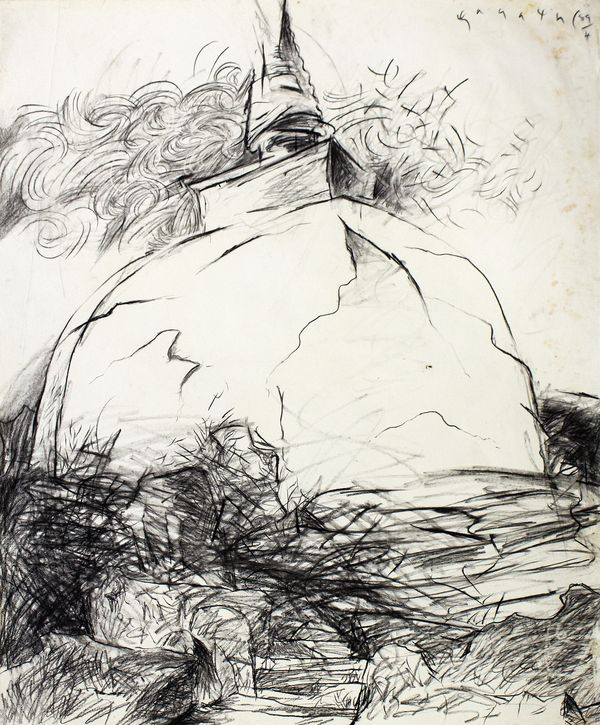
  • Jagath Weerasinghe, Ruined Landscape with a Stupa, 1989

    Jagath Weerasinghe

    Ruined Landscape with a Stupa, 1989
    Dambulla and the Broken Stupa become the spark that also ignites a dialogue between the interconnectedness of heritage conservation and nationalism in Sri Lanka. The violence that is inherent in it becomes apparent as state-driven attempts at celebrating the Buddhist history and legacy in Sri Lanka cast away the histories of the ethnic and religious minorities in the country.
    • Jagath Weerasinghe A Mom II, 1990 Woodcut print on paper 49 x 27 cm 19 1/4 x 10 5/8 in Edition 3 of 5
      Jagath Weerasinghe
      A Mom II, 1990
      Woodcut print on paper
      49 x 27 cm
      19 1/4 x 10 5/8 in
      Edition 3 of 5
    • Jagath Weerasinghe A Mom, 1990 Woodcut Print on Paper 36 x 37 cm 14 1/8 x 14 5/8 in Edition 5 of 10
      Jagath Weerasinghe
      A Mom, 1990
      Woodcut Print on Paper
      36 x 37 cm
      14 1/8 x 14 5/8 in
      Edition 5 of 10
  • Weerasinghe’s works also identify mothers as victims of a failed society caught in the crossfire of political ideologies, ethno-linguistic wars, and the overt expression of masculine power. Charged with empathy for their suffering, he essayed their harrowing experience through the dishevelled figures of mothers in his woodcut prints – corresponding with Woman with Dead Child (1903) a deeply moving image of a mother grieving the death of her young son by Kathe Kollwitz.  It is a concern that also guides the creation of works such as the  Shrine of the Innocents and Yantra Gala that ponder on the countless deaths of innocent youth and their mothers’ search for the missing children at sites of worship.
  • For this exhibition, Jagath Weerasinghe revisited the demolished 1999 public monument Shrine of the Innocents, which was built at Battaramulla to commemorate the Embilipitiya Massacre. Shrine of the Innocents, Kilinochchi: Where is my Child? (2023) was created through a collaborative process involving the bereaved mothers from Kilinochchi who left imprints of their grief on wet clay in a momentary transmission of pain. Love, anguish and hope are made visible through the clenched expression of the fist, a gesture that expresses emotional restraint. Unlike its previous iterations, the clay work is left unburnt in the hope and belief that their children are alive and will someday return. The work is accompanied by terracotta tablets on which the women have inscribed their thoughts in Tamil with the help of a nail. The language which is foreign to individuals who are unfamiliar with the script reminds them once again of a suffering and pain that they have been largely oblivious to, lost as it is in the ethnolinguistic dimension of the war.
  • The Association for Relatives of Enforced Disappearance (ARED) was founded in Kilinochchi in the years following the end of Sri Lanka’s civil war. Sri Lanka has the second-highest number of enforced disappearances in the world. According to the UN Working Group on Enforced or Involuntary Disappearances, as many as 100,000 people have been reported missing since the 1980s, the majority of them during the civil war. Several human rights organizations, including Amnesty International, have documented the use of enforced disappearances by the Sri Lankan authorities as a tool to silence dissent.