|
Chudamani Clowes (b.1966, Colombo. Lives and works in London) is a multidisciplinary artist fundamentally invested in human stories; whereby she invents characters to retell a historical past and explore issues of immigration, race and diaspora today. The artist engages with post-colonial discourse, examining the British Museum’s ethnographic archives and their impact on contemporary art. Through her work Clowes reimagines the portrayal of non-Europeans in Western museums, reclaiming her family’s colonial past and addressing themes of immigration, race, and identity. Clowes’s practice serves as a translation of history, offering a post-colonial perspective that challenges traditional narratives. She engages with a wide range of mediums including ceramic, print, performance and sculpture and incorporates unconventional materials such as banana paper, survival blankets and packaging materials in order to further her commentary.
Based in London, Chudamani Clowes holds an MFA from the Royal College of Art, London (2014) and a BA (Hons) in Fine Art from the Central Saint Martins College of Art & Design (2008). Additionally, Clowes has a Postgraduate Certificate of Education from the University of London.
|

 |
“My work weaves together personal history, colonial research, and ecological awareness. Influenced by my family’s connection to paddy fields and tea estates, and informed by research into the British Empire, I explore themes of migration, land, and empire in an effort to understand the present.” |
You frequently explore themes of migration, race, and diaspora. How do you balance personal, historical, and ecological narratives in your work?I balance the personal, historical and ecological narratives in my work by being true to myself and exploring themes that are important to me. All these areas are infused in my work because I research historical facts. In my studio, I am surrounded by artefacts from the British Empire. I visit Imperial sites and The British Museums which inform my work. My family history influences my work, as my father was a tea planter and took over after the British left Ceylon in the 1950s. There is a strong link to land from paddy fields and tea estates in our family. We have been bought up tending, caring for the land. I am trying to make sense of the world through my work coming to terms with migration, empire and ecology.
Clowe's studio in London, UK
|

|
How has your training at the Royal College of Art and Central Saints Martin shaped your artistic practice?
My training at Central Saint Martins and the Royal College of Art have had a profound effect on my practice. I try to be as innovative as possible in my work using materials and subjects. I try to choose different angles and perspectives on themes. I also belong to a very strong community of artists from the RCA on the network that meet regularly to discuss philosophical theory and most importantly visit galleries and each other’s studio. I have a good network of artists from each college who can provide help and information.
The art schools I have attended have instilled in me self-confidence and self-belief. The colleges demanded a high level of presentation. The art schools have encouraged developing ideas and striving for higher standards.
Chudamani at Saskia Fernando Gallery, Colombo, Sri Lanka, 2025
|
You work in ceramics, print, collage, performance and more. What do you enjoy about moving between so many mediums?I work in ceramics, print and collage. I really enjoy moving across these mediums. I like the dialogues I have created using these mediums. They fire each other off and I like to skip from one medium to another. I might start off with printing an image and I then realise it would look good on a painting and the ceramic structure has patterns made from painting brush strokes.I like to use contrasting elements and juxtapositions between materials and ideas. I am very influenced by Post war Abstract Expressionism artists like Robert Rauchenberg who combined basically everything and could not afford canvas and oil paint. I like his ethos of using what you find in your environment. My work revolves around texture, colour and form.
Left; Tilda Swims the Channel, Saskia Fernando Gallery, Colombo, Sri Lanka, 2025 Right: Tilda Travels to the Port, Performance, Colombo, Sri Lanka, 2025
Titles, often inspired by poetry or haiku, appear to add a reflective layer to your work. How do you approach naming your pieces?
I love to make my titles interesting and unforgettable. I found Haikus expressed the way I was feeling and the horror, graphic nature of destruction, pollution and warfare in our seas. My next series of paintings are titled after Indian Takeaway restaurants I find in London. They evoke such exoticism and colonial encounters. Titles like Raj Toot, Bombay Delight and the Taj Mahal. I named one painting after my great grandmother Corallium Manika because I feel I need to acknowledge my heritage.  Left; Bubbling hot water, Plumes bellowing gaseous air, Clouds under the sea, 2025, Mixed Media on Linen Flax, 74 x 61 cm Centre; Saline sponge garden, Floral bouquet blossoms bright, Poisons circulate, 2025, Mixed Media on Canvas, 75 x 58 cm
Right; Blossom algae forest, Pink dazzling mesmerising, Darting flying squid, 2025, Mixed Media on Linen Flax, 85 x 61 cm
|
How do you choose unusual materials like rice packets and rubber ducks? What draws you to them?I choose unusual materials because I find them in my studio or at home. I may have read a poem or a story in the news, this triggers off ideas and my fascination with these objects. The rubber ducks were used because of a poem I read called ‘When considering the long long journey of 28,000 rubber ducks’,by Kei Miller. I am also aware people have personal associations with certain objects. I am drawn to these everyday objects usually because I have an association with the particular object or they signify something homely and domestic. |


|
|
I think these unusual objects find me really ! I go to thrift shops or jumble sales. I found wooden jigsaw puzzles from my school days and this caused me to be nostalgic. This evoked in me a memory of the object and I realised by placing it in a painting. It resonated with my memory and trapped it in a painting. |

Storytelling is central to your practice. How do you navigate between invented characters, historical figures, and real-world events?At one stage I created a whole tribe called the ‘Elephant Heads’ based on the Human Zoos that were held in London in the 1900 in Shepherds Bush London. This tribe was based on the Mahout Elephant troupe who were brought to London and made to live in mock huts while Victorians paraded past them. I realised this fabrication conjuring fictional characters was constantly done in the media. I suppose its power and representation.
Left: Elephant Heads, The Griffin Art Prize Shortlist Exhibition, Griffin Gallery, London, 2014 Right: Churchill You Coral Man, Saskia Fernando Gallery, Colombo, 2025 |

|
|

|
. What are you reading at the moment?
At the moment I am reading ‘Flashlight’ by Susan Choi, one of the The Booker prize shortlist 2025. I am reading all the shortlisted books. I just finished reading the Booker winner ‘Flesh’. The book from last year's shortlist ‘The Safe House’really influenced my work. I listen to audio books all the time. I love the writing of Gaston Bachelard and Helen Cioux. |
Do you listen to music while you work? If so, what do you like to listen to?
When I am in my studio I listen to audio books and audio plays. I listen to the World service and Radio 4. I listen to some classical music like Bach and Satie.
|
|
 Clowe's studio in London, UK
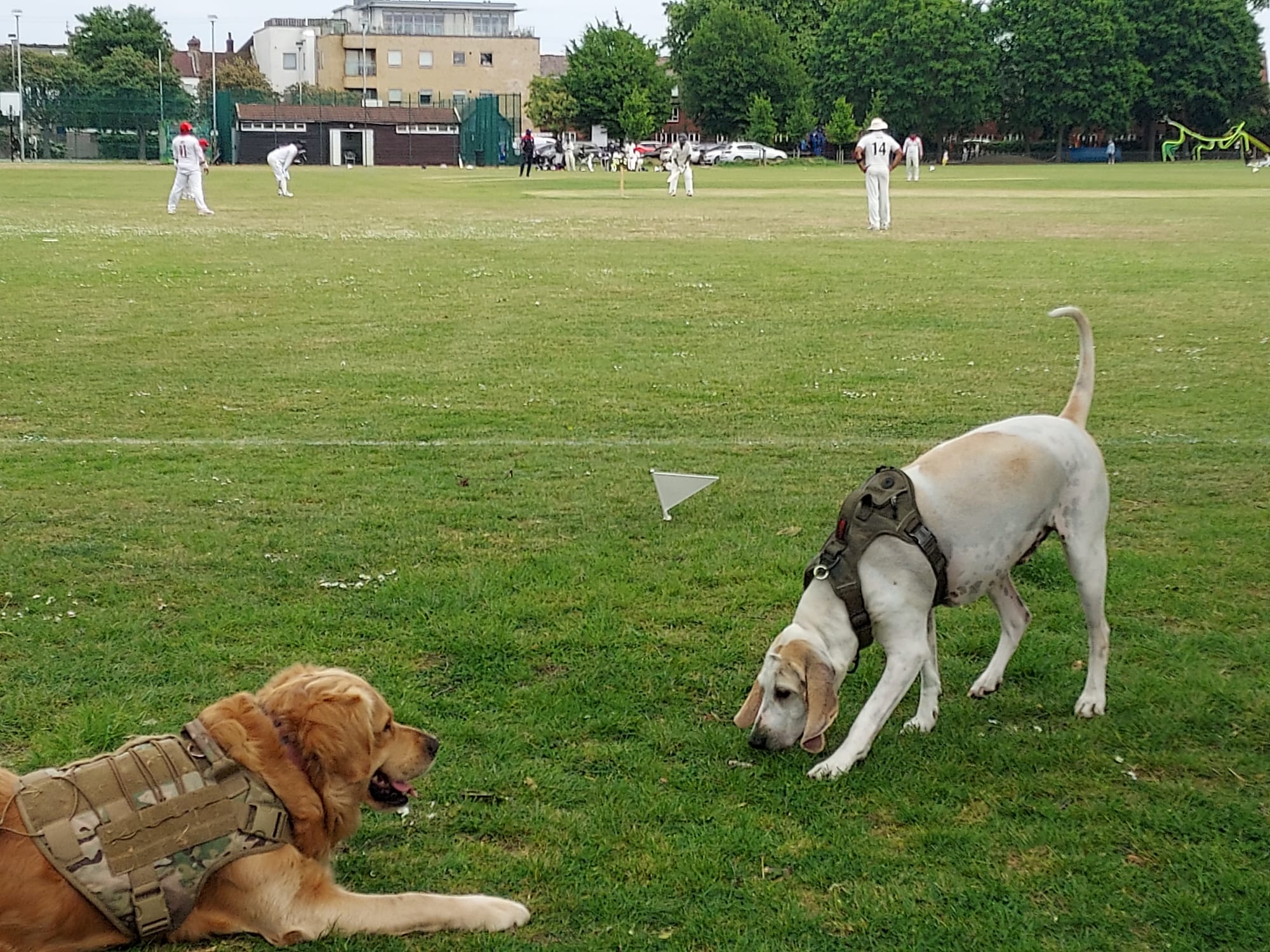
I have a golden retriever and a French deerhound, so I am up early on Wimbledon common getting muddy and very dirty. Then, I go to the studio for exactly three hours since the dogs need exercise at lunchtime. I have to focus in the studio and work very intensely as time is a very precious resource. |
Chudamani's four legged friends |
What is your advice to emerging artists?I have a huge long list of helpful tips for artists. One is to network and collaborate with each other. Find a space and make it a suitable studio and use materials you find around in your environment. Be true to yourself about what you want to say in your work and make. Be focused on budgets, especially the cost of materials, paint and canvas. Attend lectures and talks and research your topic and the dialogue you want to engage with. Make sure you keep notebooks and sketchbooks and portfolios of work. Make mind maps of your themes. Find venues you may show your work. Making sure you hold crits, where you take part in constructive criticism of work. Make sure you document work and date, label work. Keep rigorous inventory of artwork.
|
|
|

