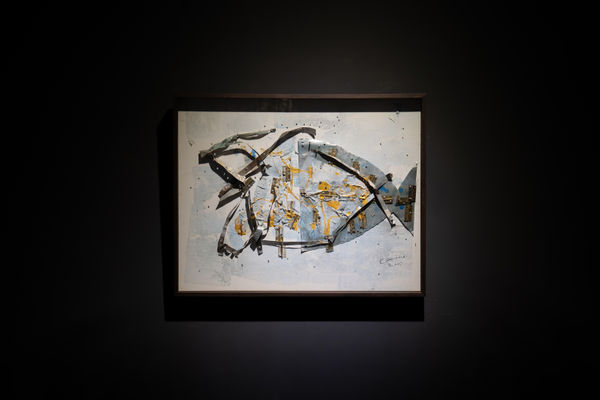
Water of Life : H. A. Karunaratne

Rooted in and Removed from
Jyoti Dhar
He wakes up at 4 am, sips his tea and listens to the radio. He turns the dial to hear the latest news on the island, before tuning into Buddhist sermons at dawn. As the light begins to permeate through the windows, he makes his way to the corner of the house, to a room filled with fuses, trip switches and shock absorbers on some days, cement, cardboard and wires on other days. The tables and surfaces in this space brim with debris from construction sites as well as materials hand-picked from hardware stores and local markets. He studies his bounty of supplies, and then he begins. Cutting, painting, bending or burning, breaking, moulding and transforming. Favouring his hands and body over workman’s tools, the artist shapes material into form. H.A. Karunaratne is 95 years old. These days his children often aid him in the making of his work. Still, he persists with his practice — something he sees as an endless pursuit. His is an intuitive, instinctual and embodied process; one where the egoic mind is stilled, and the autonomy of the activity takes over.
For Karunaratne, or ‘Karu’ as he is known, both process and product are equally significant. When asked about the meaning or purpose behind his prolific practice, spanning 1950s till present day, the artist tends to be cryptic and philosophical.“It is not easy to express (oneself) through abstract art unless you practice it throughout your life,” he says in characteristic fashion. “It is only through abstract art that you can express your inner thoughts.”[1] Karu has been described as a lone and enigmatic artist who has largely stayed away from exhibiting and selling his work. Yet he is also cited as a key figure within the field of abstraction in Sri Lanka.[2] Tracing the trajectory of his work more closely, however, suggests that Karu’s work sidesteps these easy dichotomies and labels, and does not sit easily inside the established canon. Focusing more on the contextual than the biographical,[3] this short text reviews how his work draws from and charts its own path through local and international histories of modern and contemporary art.
Crediting modernist and ’43 group member Justin Deraniyagala with sparking his artistic journey,[4] Karu went to art school in Colombo[5] in the 1950s where he was taught by renowned figures such as David Paynter and J.D.A. Perera. He tells us that such teachers played a crucial role in his early development, but also reveals that “there was not enough freedom for them (in this environment) for creative expression.”[6] In 1959, having received a government scholarship from Japan, Karu set off for Tokyo. With American occupation post-World War II having ended three years earlier, the artist found himself in a nation still in the process of recalibrating and redefining itself. For visual artists, and printmakers in particular, this manifested in a move away from modernist-collaborative methods, to one where they were working to innovative new methods, being fully autonomous and incorporating multiple media.[7] As such, Karu experimented with lithography, woodblocks, silkscreen, etchings, ceramic and collage while in the city. His work, later shown at the International Print Biennial in Tokyo,[8] incorporated “tar, printer’s ink, Chinese lacquer, oils and unheard-of materials”.[9]
This exposure to printmaking in Japan, and how it opened up and fuelled Karu’s pursuit of abstraction, is interesting to consider. Printmaking is abstract by its very nature is the abstraction of one image to make another. It is about process as much as product, involving labour of the body, and requiring a degree of ‘letting go.’ All of this manifests in Karu’s practice even today. The cultural and spiritual context within which he studied also impacted his approach to abstraction,[10] in particular the emphasis of Zen Buddhism on producing one’s essence, becoming one with the work and liberating the mind.
However, it is important to remember that these influences were not one-way or limited to Karu. Artistic exchanges in the 1950s between Europe, the U.S. and Japan included a Zen Group being formed in Germany, and American artists such as Jackson Pollock and Willem de Kooning citing Zen Buddhism as an influence. In this post-war period, several global artists were exhibiting in Tokyo and many Japanese artists were drawing from Abstract Expressionism and Colour field paintings. This sheds light on the context in which artists like Karu went from Japan to the U.S.
In contrast to his time in Tokyo, we know little about Karu’s stint in New York (1965-66), other than that he went to see museums and modern masters’ works up close. In particular, De Kooning and Pollock’s work impressed him. One could certainly see De Kooning’s black and white gestural paintings from the 1950s sharing space with some of Karu’s own,[11] as well as Pollock’s signature automatic and impulsive lines placed in conversation with some of the expressive and free-flowing forms of Karu’s canvases.[12] Digging a little deeper, however, reveals that many artists in New York in 1965,[13] including those studying graphic art at the Pratt Institute (as Karu was) were absorbed by one overwhelming preoccupation — the Vietnam War. 1965 was the year that a wave of student protests and counter-culture movements were triggered by the U.S. ground invasion. Some artists became overtly political in this moment, while others (some of whom also witnessed the aftermath of Hiroshima and Nagasaki) turned to existentialism as a way to refuse binary political positions and move beyond conveying particular meanings through their work.[14]
Considering Karu’s work against this heady mix of internationalism and war-instigated existentialism may help us to see it in a different light (especially as it continued to be shared in transnational circuits from the 1960s onwards).[15] This may be one reason why Karu continued to pursue abstraction when he returned to Sri Lanka and began teaching in the late 1970s and 1980s.[16] At this time, in response to the atrocities of the JVP uprisings, the Black July Riots of 1983 and the ensuing civil war, many of Karu’s students including Jagath Weerasinghe and Chandragupta Thenuwara were turning towards the overtly political in their work.[17] Surrounded by a sea of figuration, Karu chose to focus on expanding his practice into abstract prints, murals, sculptures and paintings.[18] One could read this focus on his work as another way of being present. His central concern in a desire for freedom and a quest for creativity is reflected in the many phases his practice underwent in the 1990s and 2000s. He describes this pursuit of stillness and nothingness against such a milieu by saying, “a void…speaks loudest.”[19]
A visit to Karu’s home studio in Nugegoda yields compelling insights into an abundant and influential life quest, spanning seven decades. At the very entrance to his home, where you are greeted by a mural embedded with shards of ceramic, to his living room filled with metallic sculptures on pedestals, to the walls and floors covered in scores of canvases layered with cardboard, protruding objects and colourful wire — every corner serves as a record of an artist who has spent a lifetime experimenting and pushing a singular practice. References to local crafts and materials parallels with modernists in Sri Lanka and abroad, as well as the overarching influence of Buddhism (not as an ideology but as a way of life) are most clear when these bodies of work are viewed together in this home studio/archival space. For Karu, as someone who has been shaped by history and place (but has also been able to liberate himself from all constraints and categorizations) what matters most is another day to see and make work, as one lifetime is not enough.[20]
END NOTES
-
In an interview with the author, March 2024.
-
Those before him include George Claessen, and those after Muhanned Cader.
-
Many of the newspaper articles in Sri Lanka on H.A. Karunaratne’s practice from the 1950s-present focus on the biographical and spiritual, rather than the processual or contextual. A contrast to this is the rich collection of texts that can be found in the book 'H.A. Karunaratne,' by Anoli Perera (2018: Taprobane Collection).
-
In an interview with the author, March 2024.
-
H.A. Karunaratne went to the Government College of Fine Arts from 1952-1958.
-
In an interview with the author, March 2024.
-
https://www.asianartscollection.com/id/Abstraction-in-Postwar-Japanese-Printmaking/39.Accessed November 26, 2024.
-
5th Tokyo International Print Biennale Exhibition, 1966.
-
Viranga, A Painter in Retreat, The Ceylon Daily News, November 1966.
-
“In Japan, in Zen Buddhism, you learn a lot about appreciation of the soul. That helps express yourself in an abstract way,” he said. In an interview with the author, March 2024
-
De Kooning also made recipes from household materials and talked about painting the image that was called up within him.
-
There are many parallels that could be drawn between the embodied, instinctual, and energetic line-making we see in Karunaratne and Pollock’s work, as well as the fact that similar artists of the time, including the works of Mexican muralists and printmakers who spent time in New York, influenced both of them.
-
H.A. Karunaratne studied at the Graphic Arts department at Pratt Institute from 1965-1966.
-
https://assets.press.princeton.edu/chapters/s30255.pdf. Accessed December 5, 2024.
-
Including Sao Paulo in 1969, the Asian Art Biennial in 1981, and the Fukuoka Art Museum in 1985.
-
H.A. Karunaratne taught at the Institute of Aesthetic Studies at the University of Kelaniya from 1975-1989 as a lecturer and established a printing press there.
-
Anoli Perera, Modernist Master Spirit, The Sunday Leader, August 31, 1997. Perera, who was also part of the ‘90s trend’ with Weerasinghe and Thenuwara, writes here about how Karunaratne’s work tries “to hide in the domain of meta-physicality.”
-
It’s important to note that he also made some figurative work – his early prints, which he gave philosophical titles, and his work in ceramics are examples of this.
-
You Look into a Dream, The Island, Sri Lanka, June 1997.
-
“This an endless process,” he says. R.S. Karunaratne, Karu Paints to Please Himself, The Sunday Observer, May 9, 1993.
-
 H A KarunaratneWater for Life, 2000Oil on Canvas140 x 100 cm
55 1/8 x 39 3/8 in -
H A KarunaratneUntitled, 2018Mixed Media on Canvas120 x 80 cm
47 1/4 x 31 1/2 in -
H A KarunaratneUntitled, 2019Mixed Media on Board102 x 64 cm
40 1/8 x 25 1/4 in -
H A KarunaratneUntitled, 2018Mixed Media on Canvas60 x 70 cm
23 5/8 x 27 1/2 in


-
H A KarunaratneUntitled, 2011Mixed Media on Board80 X 120 cm
-
H A KarunaratneUntitled, 2015Mixed Media on Canvas80 x 120 cm
31 1/2 x 47 1/4 in -
H A KarunaratneUntitled, 2018Mixed Media on Canvas80 x 120 cm
31 1/2 x 47 1/4 in -
H A KarunaratneUntitled, 2018Mixed Media on Board83 x 112 cm
32 5/8 x 44 1/8 in


-
H A KarunaratneUntitled, 2019Mixed Media on Canvas80 x 120 cm
31 1/2 x 47 1/4 in -
H A KarunaratneUntitled, 2019Mixed Media on Board64 x 120 cm
25 1/4 x 47 1/4 in -
H A KarunaratneUntitled, 2019Mixed Media on Board64 x 102 cm
25 1/4 x 40 1/8 in -
H A KarunaratneUntitled, 2017Mixed Media on Board64 x 102 cm
25 1/4 x 40 1/8 in